

How to calculate the load - bearing capacity of a landing door header?
Mar 27, 2026
Leave a message
Hey there! I'm a supplier of Landing Door Header, and I often get asked how to calculate the load - bearing capacity of these headers. It's a crucial aspect, especially when it comes to ensuring the safety and functionality of elevator systems. So, let's dive right in and break down the process.
First things first, understanding what a landing door header does. It's an essential part of the elevator landing door system. It supports the door and any additional equipment attached to it, like Elevator Door Motors. The load - bearing capacity is the maximum weight the header can handle without failing or deforming.
Factors Affecting Load - Bearing Capacity
There are several factors that come into play when calculating the load - bearing capacity of a landing door header.
Material Properties
The type of material used in the header is a major factor. Common materials include steel, aluminum, and sometimes reinforced plastics. Steel is known for its high strength and durability, which means it can generally bear more weight compared to aluminum. The material's yield strength, ultimate strength, and modulus of elasticity are important properties. Yield strength is the stress at which the material starts to deform permanently, and ultimate strength is the maximum stress it can withstand before breaking.
Header Dimensions
The size and shape of the header matter a lot. A wider and thicker header will usually have a higher load - bearing capacity. The cross - sectional area of the header is a key dimension. For example, a rectangular cross - section header with larger width and height will be able to support more weight than a smaller one. The length of the header also affects its capacity. Longer headers may be more prone to bending under load, so they need to be designed accordingly.
Load Types
The loads acting on the landing door header can be classified into different types. There are static loads, which are constant and don't change over time. This includes the weight of the door itself, the door motor, and any other fixed components attached to the header. Then there are dynamic loads, which are caused by movement, such as the force exerted when the door opens and closes. Impact loads can also occur if something hits the door or if there are sudden stops during door operation.
Calculation Methods
Simplified Calculation for Static Loads
If you're dealing mainly with static loads, a simplified calculation can be used. First, you need to determine the total weight of all the components attached to the header. Let's say the door weighs (W_d), the door motor weighs (W_m), and there are some additional accessories with a combined weight of (W_a). The total static load (W_{total}=W_d + W_m+W_a).
Next, you need to consider the support conditions of the header. If the header is simply supported (supported at both ends), you can use basic beam theory. The maximum bending moment (M) in a simply - supported beam with a uniformly distributed load (w) (where (w = W_{total}/L), and (L) is the length of the header) is given by (M=\frac{wL^{2}}{8}).
The stress (\sigma) in the beam due to bending is calculated using the formula (\sigma=\frac{M y}{I}), where (y) is the distance from the neutral axis of the cross - section to the outermost fiber, and (I) is the moment of inertia of the cross - section. You can then compare this calculated stress with the allowable stress of the material. If (\sigma) is less than the allowable stress, the header can support the load.
More Complex Calculations for Dynamic and Impact Loads
When dynamic and impact loads are involved, things get a bit more complicated. For dynamic loads, you may need to consider factors such as the acceleration and deceleration of the door during opening and closing. This can be modeled using equations of motion.
Impact loads are even trickier. You can use empirical formulas or computer - aided engineering (CAE) software to estimate the impact forces. CAE software, like finite element analysis (FEA) programs, can simulate how the header will respond to different types of loads. It takes into account the material properties, geometry, and boundary conditions of the header to provide a more accurate analysis of its load - bearing capacity.
Importance of Accurate Calculation
Accurately calculating the load - bearing capacity of a landing door header is crucial for several reasons. Safety is the top priority. An under - designed header may fail under load, which can lead to serious accidents, such as the door falling or malfunctioning. This can endanger the lives of passengers and maintenance workers.
From a cost - effectiveness perspective, over - designing the header means using more material than necessary, which increases the cost of production. On the other hand, under - designing can result in frequent repairs and replacements, which also add to the overall cost in the long run.
Our Role as a Supplier
As a Landing Door Header supplier, we're committed to providing high - quality products. We have a team of experts who are well - versed in these calculations. We use the latest design and manufacturing techniques to ensure that our headers meet or exceed the required load - bearing capacities.
We also understand that every elevator system is unique, with different requirements. That's why we offer customized solutions. Whether you need a header for a small - scale residential elevator or a large - capacity commercial elevator, we can design and manufacture it to your specific needs.
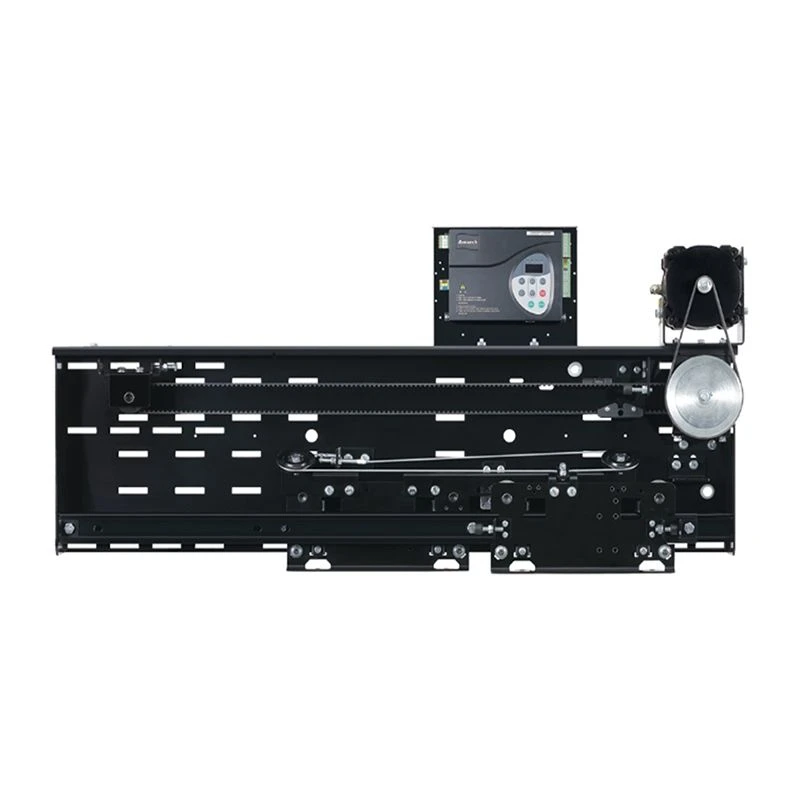

In addition to landing door headers, we also supply other elevator parts, such as Elevator Door Motors and Ceiling For Elevator Car. This means you can get all your elevator - related parts from one reliable source.
If you're in the market for landing door headers or other elevator parts, we'd love to have a chat with you. We can discuss your specific requirements, perform the necessary load - bearing capacity calculations, and provide you with a competitive quote. Don't hesitate to reach out and start a conversation about your procurement needs.
References
- "Mechanics of Materials" by Ferdinand P. Beer, E. Russell Johnston Jr., John T. DeWolf, and David F. Mazurek.
- "Elevator Technology Handbook" from industry - specific elevator engineering research.